


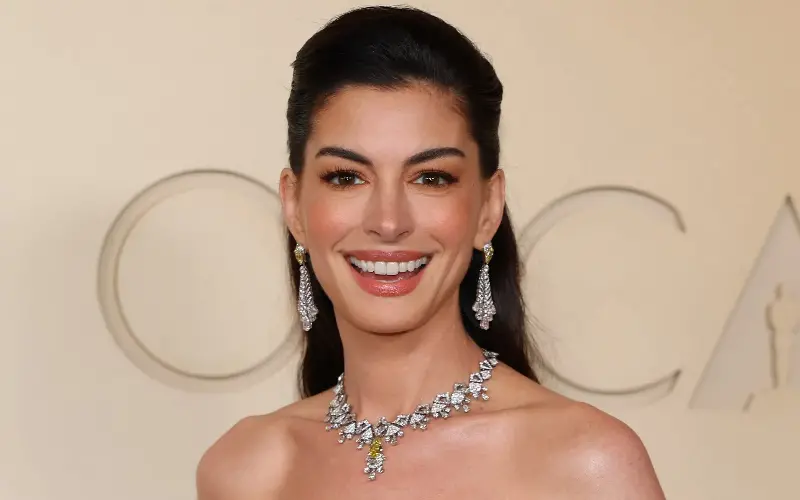
Anne Hathaway is back – which might come as a surprise to readers who hadn’t realised she’d left in the first place. Officially she didn’t, though good luck naming any of the films she’s appeared in since Covid.
But the 43-year-old actress’s career is about to rally in style. She has The Devil Wears Prada 2 later this week, Christopher Nolan’s star-studded The Odyssey in July, the prehistoric time-travel fantasy The End of Oak Street in August, and an adaptation of a Colleen Hoover book (everyone wants a slice of the internet’s favourite author) before the year’s end. A possible bid for a second Oscar is also in the works in the form of Ron Howard’s Afghan war drama Alone at Dawn – while almost 14 years after Les Misérables, she’s even singing again in Mother Mary, in which she plays a haunted pop icon mounting a comeback.
Hathaway’s own return to the frontline of cinema comes a little more than a decade after she fell afoul (through no fault of her own) of an odd and icky confluence of cultural forces. It’s taken this long for the damage to her public image to recede – but working out what caused the damage in the first place is a task in itself.
According to some, she was too enthusiastic, too earnest, too humble for comfort; to others she was brittle, entitled, insincere. She was the soul-baring, Oscar-grabbing star of Les Misérables – so pretentious! – who had allegedly practised her acceptance speech for weeks before the ceremony (gushing “It came true!” when handed the statuette) but also the millennial Julia Roberts knock-off from such cheesy romcoms as The Princess Diaries, Valentine’s Day and Bride Wars – so superficial!
What really rankled, beyond her confidence and poise, was that she was equipped with the talent to back those qualities up. And that particular combination – gifted; knows it – was a red rag to social media, which was about to rebuild the machinery of celebrity in the years ahead. Parasocial fandom (referring to fans who develop intense, one-sided obsessions with celebrities) was suddenly in: it was boom time for down-to-earth stars who could double as imaginary best friends.
The poised and polished Hathaway, by contrast, always looked meticulously rehearsed – rendering her image so naff and passé that she believed she actually lost work.
“A lot of people wouldn’t give me roles because they were so concerned about how toxic my identity had become online,” she later told Vanity Fair. Not everyone, though: she went on to describe director Christopher Nolan as “an angel” for casting her in Interstellar while her personal brand was at its lowest ebb. But her theory broadly rings true: compare her extraordinarily busy and varied late Noughties (Brokeback Mountain, The Devil Wears Prada, Get Smart, Rachel Getting Married, Bride Wars) with the threadbare schedule of just a few years later: beyond Les Mis and a couple of Nolans (Interstellar and The Dark Knight Rises), her highest-profile roles came in the weedy 2011 adaptation of David Nicholls’s One Day and the animated Rio films, in which she voiced a macaw.
“I don’t know if [Nolan] knew that he was backing me at the time”, she went on, “but it had that effect. And my career did not lose momentum the way it could have if he hadn’t backed me.” Even so, only Nancy Meyers took a chance on her as a lead, in 2015’s underrated The Intern, until 2018’s middlingly received all-female heist caper Ocean’s 8.
So what prompted this widespread outbreak of what became known as “Hatha-hate”? (Disappointing; “Anne-tipathy” was right there.) Essentially – and if you look very hard, you might be able to spot some sexism at work here – it was her looks and success.
A psychology professor, Terry Pettijohn, told online magazine Salon in 2013 that Hathaway’s face was too sharply defined to chime with the upbeat post-recession mood. “When times are good, we prefer actresses with rounder faces,” he said. “They convey these ideas of fun and youth… As the economy improves, Hathaway may just be a reminder of bad times.” Perhaps there was something in it: the most popular actress at the time was the adorable Jennifer Lawrence, then flying high in The Hunger Games and X-Men franchises. But even so, framing Hathaway as the physiognomic embodiment of the global financial downturn is arguably a bit harsh.
Also on the ever-expanding list of crimes was her crisp intonation in speeches and interviews – which, a speechwriter told CNN, came off as overly rehearsed. Again, this stood in stark contrast to Lawrence, whose breezy, down-to-earth vibe helped make her Hollywood’s queen of the 2010s. (Though Lawrence too would later experience a fall from public favour after her own public persona went out of fashion around 2020: same nonsense, different decade.)
If Lawrence was social media’s goofy best pal with no filter, commentators often likened Hathaway to the ambitious young drama whizz most of us remember (and were probably rubbed the wrong way by) at school. “She’s got this theatre-kid thing where she adopts the mood of every situation she’s in, but wildly overcompensates every time,” wrote The Atlantic’s Richard Lawson – perhaps thinking of her perky stint as a 2011 Oscars presenter, alongside a mellow-to-the-point-of-brain-dead James Franco.
Franco, whose own career would later hit the skids following a series of allegations of sexual misconduct, managed to escape this debacle largely unscathed. But for Hathaway – who had initially turned down the gig until Franco persuaded her to take it – her attempts to send up her try-hard public image created exactly the wrong kind of content, and in an interview the following year, she rued her “slightly manic and hyper-cheerleadery” approach.
But the damage was done. In the New Yorker in 2013, Sasha Weiss described Hathaway as the “archetype for the happy girl”, contrasting her with the “inscrutable” unsmiling women to be found elsewhere on the red carpet.
“She stands with her long arms at her sides, looking directly (even a little pleadingly) into the camera,” Weiss wrote, adding: “her smile is toothy and takes up half of her face. It’s a look of unfettered excitement and openness, an expression of high-wattage joy that reminds me of none other than a nine-year-old girl about to dig into a big slice of birthday cake.”
How did she reset? Exactly the way you’d expect an ambitious theatre kid to: with hard work. After the 2019 releases of Serenity and The Hustle – both widely panned, and deservedly so – she tacked away decisively from froth. She made the brooding investigative thriller Dark Waters with Todd Haynes; a Joan Didion adaptation, The Last Thing He Wanted; the terrific Armageddon Time; and the noirish thriller Eileen. (Robert Zemeckis’s ramshackle 2020 adaptation of Roald Dahl’s The Witches, in which Hathaway played the Grand High Witch – and well, despite the furore over her prosthetics – was the exception.)
She was able to flex her comic muscles again – and with more subtlety and finesse than in, say, Bride Wars – in the 2024 romantic age-gap comedy The Idea of You. And she tried her hand at a suburban period thriller, Mother’s Instinct, opposite her former Interstellar co-star Jessica Chastain: a not dissimilar performer who had managed to navigate the perilous 2010s with more success.
All of the above paved the way to her busy 2026, and above all The Devil Wears Prada 2. The film is a splashy millennial nostalgia play, likely destined for enormous box-office success, that catches up with the elite media players of the 2006 original who have been buffeted by the cultural shifts of the 2010s but are somehow still standing. One would imagine Hathaway can sympathise.
The Devil Wears Prada 2 is in cinemas from May 1