



Come back tomorrow for numbers 30 to 11
As a film critic of 20 years and a film lover of at least 20 more, I don’t even want to guess how many of the damn things I’ve seen – probably something in the high four or even low five figures. So whittling them down into an all-time top 50 has been, as I’m sure you can imagine, an absolute nightmare.
What does greatness in this context even mean? Critical or commercial success? Artistic influence? The presence of Scarlett Johansson? As I scroll up and down the entries below, it feels like I get further away from being able to pin down a definition with every stroke of the trackpad. What I can say with some certainty, though, is that this list splits the difference (pretty nattily, I think) between a catalogue of deeply personal loves and a canon that newcomers to the medium could work their way through and thereby experience the very best of what it’s got.
There are naturally many howling omissions, including an absence of titles from some of my favourite directors working today. But this is because I’m not yet sure which of their great films is the great film – or whether they’ve even made it yet. Also, since (contrary to the regular obits) cinema isn’t dead yet, fixating on its golden ages would have felt wrong. So if something recent struck me as among the best things I’ve ever seen, it’s on here. Anyway, no more excuses. A banquet awaits. Feast on these and you’ll see what the movies can do.
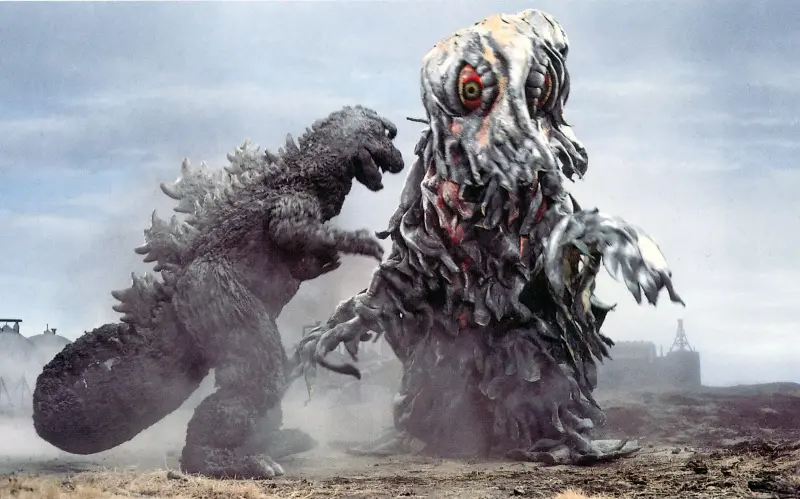
50. Godzilla vs the Smog Monster (1971)
Yes, alright: this list should probably have opened with a drum roll of gravitas. But did you really want this thing to begin with 150 words on Italian neorealism? Films are (or at least can be) a source of near-boundless joy – and this early escapade for Japan’s pre-eminent city-stomping lizard, also known as Godzilla vs. Hedorah, unfolds with a puppyish devotion to its viewers’ delight. The Godzilla series, which turned 70 in 2024, is cinema’s longest-running franchise and, much in the same way as James Bond is to the UK, its giant star has always served as an avatar for his home nation’s fixations and fears.
As Japan flourished in the mid-20th century, the creature originally conceived as a terrifying symbol of atomic war grew into a courageous yet playful national guardian. Here, he’s an outsize poster-child for clean nuclear power, and battling a vile blob that transforms via the ingestion of various pollutants into the nastiest piece of work Godzilla would ever face.
The extensive list of perfect moments includes a tide of sentient sludge invading a nightclub and momentarily submerging a kitten, and Hedorah powering himself up by sucking in the smoke from a filthy factory chimney, like a gargantuan bong hit. Not the most august film on this list, it’s here for the best reason of all: it is impossible to watch without an ear-to-ear grin.
Where to watch: Apple TV
49. Bicycle Thieves (1948)
When Vittorio de Sica filmed this hard-scrabble drama, in which a son helps his father scour post-war Rome for the stolen bicycle he needs to earn a crust, Mussolini had been executed barely two years earlier and all of Italy was in disarray. Stories like the one the film depicts were being lived live, in and around the shoot.
Rome’s Cinecittà studio complex had been first gutted by the Nazis then bombed out of commission by the Allies, so the only place to make movies was out in the streets. De Sica used non-professional actors. The Italian film business refused to fund Bicycle Thieves, and later likened it to “dirty washing”: it gives a public airing to the sort of national image they didn’t want seen.
Around the world, though, its heart-rending plot and desperate images struck an instant chord. The father’s job, incidentally, is hanging posters for American movies – such as Gilda, starring Rita Hayworth – and much of the film’s lasting power comes from the contrast between that glamour and the rubble-strewn streets of a mighty city at an all-time low.
Where to watch: Curzon
48. The Lord of the Rings (2001-03)
Walt Disney and George Lucas had previously toyed with the idea of adapting JRR Tolkien’s saga. But a proposal from a Kiwi upstart called Peter Jackson – shoot the whole thing in a single sitting in his native New Zealand in the style of a plein-air historical epic rather than a stage-bound fantasia, then release it as a trilogy over three years – prompted New Line to stump up the $281m budget.
Its sheer magnificence still astounds: Tolkien’s world is realised so plausibly it’s as if you can sink your toes into its turf. Its quarter-century-old effects have barely aged, while the performances (especially from Viggo Mortensen, Ian McKellen and Christopher Lee) have a depth and dignity rarely seen since on productions of this scale. On the other hand, it ushered in the age of the mega-franchise and must shoulder the blame for the surfeit of superhero films that followed.
Where to watch: Apple TV, HBO Max, Now
47. Body Double (1984)
Alfred Hitchcock’s Rear Window is a tremendous thriller about voyeurism and impotence – two intertwined male manias and vintage cinematic fixations – and an obvious contender for this list. Yet it took Hitchcock’s fiendish apostle, Brian De Palma, to draw out the full sleazy potential of its conceit, 30 years later.
In the Hollywood Hills, Jake Scully (Craig Wasson), a hopeless aspiring actor, lands a house-sitting gig in an absurd modernist flying saucer of a place with unbroken, telescope-assisted views of a nearby villa whose stunning inhabitant (Deborah Shelton) has a fondness for dancing nude. The woman becomes Jake’s obsession, which leads him in turn to a bizarre, unsettling doppelgänger murder-mystery plot. The suspense throughout is positively slinky – never less so than in a cat-and-mouse pursuit through a Los Angeles shopping mall, during which the viewer feels agonisingly trapped by Jake’s own drooling paralysis.
Where to watch: Apple TV, Sky Store, BFI Player
46. Star Wars (1977)
All true Star Wars fans know that at least 50 per cent of the franchise is awful – and, until very recently, I would have been loath to include anything from it on this list. Then I attended a British Film Institute (BFI) screening of George Lucas’s entirely untinkered-with 1977 film from a Technicolor release print and its charms hit me like a Death Star superlaser beam to the forehead. I’d forgotten how completely mad Star Wars once was: people running around the Tunisian desert in dressing gowns while the Tin Man from The Wizard of Oz argues with a bin.
To watch the film in its original form is to rediscover its essential magic; its gaps and rough edges are crucial to its imagination-seizing power. For good and ill, it changed the industry forever in terms of both storytelling and craftsmanship. As the 50th anniversary of its release approaches, the best imaginable way for its owners at Disney to pay tribute to its legacy would be to prise this version out of the vault, and let us all see exactly where the revolution began.
Where to watch: Disney+, Sky Store, Apple TV
45. Interstellar (2014)
In Hollywood’s most creatively conservative era to date, Christopher Nolan has carved for himself a unique and enviable niche. Studios regularly hand the London-born film-maker creative carte blanche and nine-figure budgets; and he repays their faith (nearly) every time.
There’s no widespread consensus on which of his films is the definitive Nolan picture. But for me, his finest so far is the one that ties together all of his signature concerns – the nature of heroism, the call and churn of fate, the surprising malleability of time – with more tenderness and humanity than can be found anywhere else in his filmography.
On its release, I remember being astonished that so many other reviewers hadn’t recognised Interstellar as the masterpiece I thought it so obviously was, but it does rather look as if everyone’s coming around in the long run. Viewed in the cinema, ideally in Nolan’s preferred 70mm or Imax formats, it delivers something I’ve never quite felt from another film: a wholly secular religious experience.
Where to watch: HBO Max, Apple TV, Sky Store
44. 12 Angry Men (1957)
Getting a friend or dependent hooked on classic cinema is easy: show them 12 Angry Men, and then simply let nature take its course. Sidney Lumet’s irresistible courtroom drama, in which Henry Fonda wins over a truculent jury, member by member, is as fresh today as it must have felt 69 years ago – with each of its potential limitations (the unremarkable single location, the black-and-white photography, the obviously tight budget, the unnamed characters) only serving to tighten its dramatic grip.
It’s less about the innocence or guilt of the defendant, who is facing a death sentence for murder, than the importance of reasonable doubt as a civilising principle – and therefore is every bit as relevant in our bay-for-blood social-media age as it was in the McCarthyite mob-justice era of its release. Adapted from a stage play yet cinematic to the core, the film is a masterclass in mood manipulation, from the subtly charged camera angles to the performances from Lumet’s extraordinary cast, whose characters seem to give away their secrets almost against their will.
Where to watch: Amazon Prime Video, Apple TV, YouTube
43. Tár (2022)
Here is a sorry indictment of the post-Covid state of popular cinema. The thought that anyone might want to make a darkly comic psychological thriller about a female conductor struck cinema-goers in 2022 as so utterly alien that many assumed that Todd Field’s first film in 16 years must be a biopic of a real figure of whom they hadn’t heard. Nope! As written by Field and played by Cate Blanchett, Lydia Tár is gloriously, dazzlingly fictional: an instantly legendary character whose vertiginous downfall – or rather cancellation – served as a provocative parable of power and accountability in the notionally enlightened modern arts world.
The tonal tightrope-walk it performs is Cirque-de-Soleil-level perilous: come for the riddling subtexts, stay for the zany bedlam. (Lydia variously threatens to beat up an eight-year-old child and storms on stage to lamp a rival mid-baton-flick.) Every bit as dark and sticky as its namesake, once Tár gets in your hair, it’s not coming out.
Where to watch: YouTube, Apple TV, YouTube
42. Casablanca (1942)
For a list such as this, round up the usual suspects, as Claude Rains’s Captain Louis Renault once memorably said – and Casablanca will inevitably be among them. Why? Because it’s a wartime romance in which the romance and the war are so hopelessly entangled in the lives of its participants, Humphrey Bogart’s suavely jaded nightclub impresario Rick Blaine and his former lover, Ingrid Bergman’s Ilsa Lund, that they can no longer tell where one ends and the other begins. And nor can the audience, which gives the film its heartbreak and heat.
Ilsa needs papers to escape the Vichy France-controlled Moroccan port where Rick’s Café Américain sits in cooling swirls of piano jazz and smoke; if he helps her – and her heroic new husband too – he’ll ensure he’ll never see her again. Written on the hoof during the shoot, it may be the most quoted (and misquoted) film here – perhaps in part because it juggles such deep metaphysical concepts with a debonairly light touch. For Casablanca’s thwarted couple, life isn’t a linear journey through time, but a collection of stories to dip in and out of as desire and memory demand. Rick and Ilsa might be fated to be apart in the future, but in the past they’re still together: they’ll always have Paris, and so too will we.
Where to watch: Apple TV, HBO Max, Now
41. The Piano (1993)
At whatever age you discover it, Jane Campion’s early-career gothic knockout feels like a formative novel you read in your teens. It’s earthy, melancholic and vigorously sensual in ways that instantly seep beneath your skin. Like something Thomas Hardy might have come up with if he’d emigrated to New Zealand, it centres on an arranged marriage: the parties are Ada (Holly Hunter), a Scotswoman who hasn’t spoken since childhood, and Alisdair (Sam Neill), a settler on North Island she has never previously met.
Months later, the bride-to-be and her daughter (a nine-year-old Anna Paquin) find themselves and their belongings strewn along a mysterious shore – among them the piano that has long served as Ada’s voice, and which Alisdair is in no hurry to lug back to the farmstead. A swarthy neighbour (Harvey Keitel) takes an interest in this new arrival, and under the pretence of music lessons, forbidden passions catch. Though rightly garlanded with prizes in its day, it has managed to remain out on the fringes of the canon, every bit as wild and mist-soaked as it ever was.
Where to watch: YouTube, Apple TV, Curzon
40. Certified Copy (2010)
Tell a non-cinephile that some of the 21st century’s most innovative directors came out of Iran – that fanatically authoritarian and repressive Middle Eastern state – and they will probably think you’re pulling their leg. But those who have already discovered the films of Jafar Panahi, Asghar Farhadi, Mohsen Makhmalbaf and Abbas Kiarostami know better.
This was the first of only two films that Kiarostami would shoot outside his native country, and at first blush – it opens at a book signing in rural Tuscany with Juliette Binoche in the audience – we seem to be on classic Euro arthouse terrain. Yet appearances, however gorgeous and glamorous, are not to be trusted. Binoche and the author she’s come to see, who is played by the English opera singer William Shimell, hit it off and schedule a date for the following morning.
Yet during this chic rendezvous, when an elderly café attendant mistakes them for a long-married couple, we realise they’ve somehow become one. So were they play-acting estrangement initially, or feigning familiarity now? Or has their love-life somehow become cosmically locked on fast-forward? Kiarostami is less interested in furnishing us with a solution to this seductive puzzle than in using it to explore the sexy proximity of truth and charade. It’s a film whose strange effects linger forever, including a close-up of Binoche fixing her lipstick and earrings in a hotel room mirror that must be the most cryptically charged I’ve ever seen.
Where to watch: Mubi, Apple TV, Curzon
39. Les Demoiselles de Rochefort (1967)
The French New Wave was never more fun than when its leading lights were riffing on vintage American cinema, reworking old Hollywood genres into something startling and fresh. In the musicals of Jacques Demy, all the romance and artifice of classic MGM productions comes tumbling out into the messy contemporary world.
The most glorious of all is this outrageously tangled ensemble piece, in which the arrival of a carnival in the southwestern port town of the title wreaks romantic havoc in some of its residents’ lives. That MGM legend, Gene Kelly, turns up as an American composer who passes through while on tour, but the film’s homegrown stars are real-life siblings Catherine Deneuve and Françoise Dorléac, who play the musically gifted (and highly eligible) twin sisters, Delphine and Solange. The score, by Michel Legrand, is a dream, and the dance numbers executed with winning TV variety show snazz. That Dorléac died in a traffic accident barely three months after its release gives the film’s celebration of passing pleasures and its awareness of life’s ephemerality an additional bittersweet ache.
Where to watch: Apple TV
38. A.I. Artificial Intelligence (2001)
Steven Spielberg seems to flicker in and out of fashion every few years, but his extraordinary versatility, underpinned by a distinctive and intuitive cinematic sense, places him among the greatest half-dozen film-makers America has ever produced. His best work tends to fuse his two longest-running concerns: intimate broken-home drama and eyeball-widening, grand-scale amazement.
We’re talking ET: The Extra-Terrestrial, Close Encounters of the Third Kind, War of the Worlds – and above all, this quietly staggering sci-fi Pinocchio fable, in which an android child, Haley Joel Osment’s David, scours the world for a love that he’s been programmed to strive for, but is fated never to receive. On A.I.’s release, much was made of the fact that it began life as a pet project of Stanley Kubrick’s, which he passed on to Spielberg a few years before his death. The old rascal knew exactly what he was up to: the film turns Spielberg’s famous sentimental instincts against themselves, in its evocation of a world in which humankind’s need for love eventually outlives the species itself. It was dizzyingly ahead of its time 25 years ago, and feels painfully relevant now. How on earth it’ll play in 2049 one shudders to think.
Where to watch: Amazon Prime Video, Apple TV, Sky Store
37. There Will Be Blood (2007)
Although a set of signature concerns run through all 10 of Paul Thomas Anderson’s films – the deadly power of charisma, the plight of the lonely soul, the earthly and spiritual undertows of modern America – each individual title zings in from an angle that feels utterly fresh.
The film to harness his powers with the most fearsome acuity is this 2007 frontier epic, in which a flinty oil prospector (Daniel Day-Lewis) and wily preacher (Paul Dano) grapple in the southern Californian dirt for the soul of a nation that’s still trying to work out what it is. The lead performance from Day-Lewis is as towering and penetrating as one of his character Daniel Plainview’s monstrous oil derricks; his eventual victory over Dano’s Pentecostal schemer, Eli Sunday, is as total as it is hollow.
Plainview is one of cinema’s great characters, embodied by one of its greatest actors; he’s a figure of total psychological plausibility yet also mythological mystery and resonance. “I’m finished,” he finally cries, since like Alexander the Great, he has no more worlds left to conquer. But the country he helped forge is just getting started.
Where to watch: YouTube, Apple TV, Sky Store
36. High and Low (1963)
Postwar Japan gave us four titans of cinema: Yasujiro Ozu (the contemplative minimalist); Kenji Mizoguchi (the tragic poet); Mikio Naruse (the melancholic realist); and Akira Kurosawa (the specialist in epic sword battles and hardboiled Tokyo noirs). No prizes for guessing whose films are the most widely watched today.
Kurosawa’s 1954 magnum opus Seven Samurai remains his most influential film, but this sinuous police procedural tops it for both formal innovation and relentless directorial verve. Toshiro Mifune stars as Gondo, a shoe-industry bigwig whose son is apparently kidnapped by a shadowy figure – except, by sheer chance, the crook mistakenly abducts the son of Gondo’s long-serving chauffeur instead, creating a prickly scenario in which paying the enormous ransom and thereby winning public approval has to be weighed against the financial ruin it would entail.
The film is split cleanly in two: a static first act set in Gondo’s stylish Tokyo apartment gives way to a second that slinks all over the city like a hungry panther, as Gondo and the police put into action an intricate plan that involves throwing the cash from a high-speed train as it thunders from Yokohama to Osaka, followed by a long-form pursuit as the cops close in on their prime suspect. The plot, adapted from the American novel King’s Ransom, encompasses postwar corporate scheming and demi-mondial sleaze, and is as conceptually rich as Kurosawa’s staging and camerawork are riveting. A cat-and-mouse chase through a nightclub is obviously bravura stuff, but even the simpler moments astonish: there is a particular close-up of Gondo on the phone with his wife beside him which hits so dramatically in context that the first time I saw it I almost fell out of my seat.
Where to watch: BFI Player, Apple TV, Amazon Prime Video
35. Back to the Future (1985)
We’re so familiar with Robert Zemeckis’s comic sci-fi masterpiece that it’s hard to recognise what a deeply peculiar film it has always been. The journey made by Marty McFly from the crummy 1980s Hill Valley to its idyllic 1950s past is essentially the reverse of the one George Bailey makes in It’s a Wonderful Life, from Bedford Falls to Pottersville, while its happy ending hinges on the protagonist getting his (rather attractive) mother to shag his weedy father-to-be instead of him.
Yet the star-making central performance by Michael J Fox, the inspired special effects and the seamlessness of Zemeckis and Bob Gale’s broad yet intricate screenplay make the whole thing flash past in a rush of unbridled joy: it’s so cleanly constructed it makes time travel seem not just conceptually possible, but as logical as the invention of hoverboards. (The two sequels, both great in their own right, also compound the pleasure of rewatching the original, which is rare.) Zemeckis saves his most outrageous disregard for his audience’s nerves for the climax, in which Marty and Christopher Lloyd’s Doc Brown must time the former’s return trip to his own teens to the split second of a lightning strike.
Where to watch: Now, Apple TV, Sky Store
34. Gentlemen Prefer Blondes (1953)
Howard Hawks was Hollywood’s golden age personified: noirs, westerns, adventures, screwball comedies and musicals all studded his portfolio, and he directed some of the best of each we ever got. This luxurious musical comedy, which came to the screen (via Broadway) from a 1925 Anita Loos novel, is the sort of film you feel lucky exists. Marilyn Monroe and Jane Russell star as two vivacious all-American showgirls whose friendship is as fast as their attitudes to men are poles apart. Whereas Monroe’s Lorelei Lee prizes wealth and devotion in a suitor, Russell’s Dorothy Shaw is more inclined towards the hale and hunky, and isn’t especially concerned if they don’t stick around.
At the time of the film’s release, both actresses were already established sex symbols, but men’s preferences turn out to be irrelevant here, making the title a mischievous sleight. As the girls sail to France for Lorelei’s wedding to her rich (if dainty) fiancé, Dorothy spends much of her time on board flirting with the entire US male Olympics squad, while the script doesn’t so much thwart Lorelei’s gold-digging tendencies, as downright endorse them as a natural part of the capitalist marriage market. Monroe and Russell are both effortless icons and the songs a total joy, with Jack Cole’s choreography and William Travilla’s costumes making every number pop like a champagne cork.
Where to watch: YouTube, Apple TV, Amazon Prime Video
33. Portrait of a Lady on Fire (2019)
You may have heard about “the male gaze”: a term used to describe the very masculine way films tend to look at the world, and all of the implicit assumptions and attitudes that are bundled up with it. (It’s a philosophically complex conceit, but can just about be summed up with the word “phwoar!”) The feminine equivalent is considerably rarer – blame the gender imbalance in directing for starters – but it has never been more lucidly or movingly practised than in this sublime windblown period romance from France’s Céline Sciamma, in which an artist (Noémie Merlant) is hired to paint the marriage portrait of a young gentlewoman (Adèle Haenel). The pair embark on an intense yet tender romance that’s forged entirely in the heat of looking, as the artist surveys her subject during a number of sittings at her family’s lonely château on an island off the Breton coast.
As viewers, we experience and participate in the female gaze in action: in place of voyeurism and objectification are looks that are met, acknowledged and returned. There’s more to Sciamma’s film than this – it’s also a powerful exploration of female solidarity, and its climax is a total emotional wipeout. But for a medium steeped in the XY perspectives of Alfred Hitchcock, Michael Bay and so on, Sciamma’s approach is both revelatory and inexpressibly moving, like discovering a few new colours in the visible spectrum that had been there all along.
Where to watch: ITVX, Apple TV, BFI Player
32. Fargo (1996)
Fargo is a feast of the Coen brothers’ signature interests and tics, starting with the ill-conceived get-rich-quick scheme hatched by William H Macy’s hapless car dealer Jerry Lundegaard, who decides to have his own wife kidnapped in order to extort a five-figure sum from his stingy father-in-law. The plan, which depends on two extraordinarily gormless hit men, goes even more badly than you’d expect, and soon enough Frances McDormand’s unassuming (and pregnant) local police chief, Marge Gunderson, is investigating a trail of chaos and bloodshed that leads directly back to the Lundegaard bungalow.
The opening caption which claims everything that follows is true has since become one of cinema’s most notorious fibs, but this sober piece of scene-setting is central to the Coens’ game here, which is to make you marvel (and chuckle) at the extraordinary venality and stupidity of humankind when caught in a pinch. As in all of the brothers’ films – even the religious ones – God is nowhere to be seen, though the warmth and gentle eccentricity of McDormand’s performance gives it a humane edge over some of their bleaker top-tier works. It became the Coens’ first out-and-out international hit and was nominated for seven Oscars, winning two; instantly turning the pair from an acquired taste into a required one.
Where to watch: Mubi, Apple TV, Sky Store
31. Uncut Gems (2019)
Quentin Tarantino declared recently that 2019 was the “last year of movies” – i.e., the final point at which films were given space to find a cinema audience, before the now-customary gallop to streaming platforms kicked in. Yet ironically, it was thanks to Netflix that international audiences were able to watch that year’s very best film. You could describe Uncut Gems as a black comic thriller, but it’s closer to a coronary thrombosis in audiovisual form: it remains one of only two films I’ve ever seen to prompt a viewer to walk out of a screening while shaking their head in despair at the protagonist’s relentlessly terrible choices. (The other was The Wolf of Wall Street.)
Said hero, played by Adam Sandler in a performance towards which his entire career might have been building, is Howard Ratner: a suave but frantic New York jeweller and gambling addict who is forever outrunning and/or outmanoeuvring his shady creditors, with just enough success to survive. Written and directed by brothers Josh and Benny Safdie, the film has the enveloping energy, style and wit of great Martin Scorsese while the narrative whooshes along on the vitality of New York City itself, which churns through the film like a river that’s always right on the verge of breaking its banks.
Where to watch: Netflix
Come back tomorrow for numbers 30 to 11