



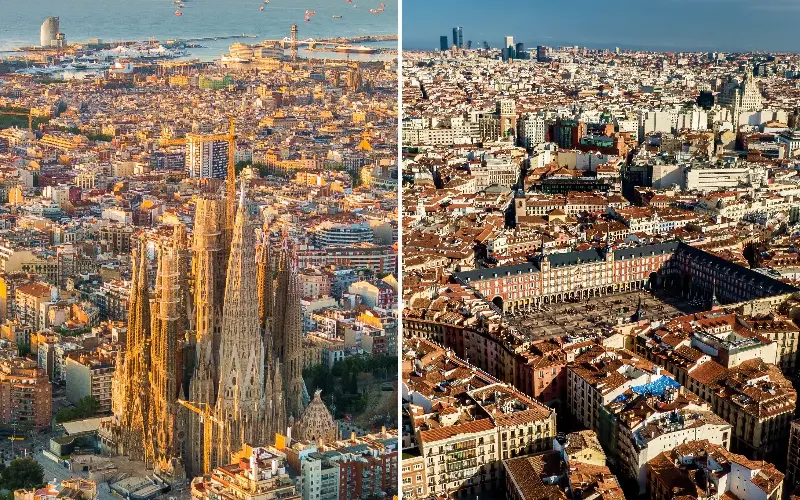
Spain’s two biggest cities are more than 300 miles apart and historically, culturally and architecturally very different. I love and have lived in both of them, and although there is much talk of rivalry between Madrid and Barcelona, in my experience, it is their stark differences that make living in one and visiting the other so wonderful.
Madrid’s population (3.5 million) dwarfs Barcelona’s (1.7 million), yet Barcelona often feels like the larger of the two cities. This is largely thanks to its sprawling nature and the patchwork of contrasting neighbourhoods that run the gamut from Gothic to bohemian to beachside.
Both are beloved by foreign tourists, but here Barcelona unquestionably takes the crown, too, attracting 13.4 million international visitors last year, compared to Madrid’s 9.1 million. The Spanish capital is certainly on the up when it comes to attracting British tourists, luring us with its art, food and nightlife, but Barcelona has been in pole position ever since the highly successful Olympic Games in 1992 pushed the city firmly into the global spotlight (as well as being a catalyst for a far-reaching programme of urban improvements and redevelopment).
I have witnessed both cities change radically over the past four decades and while Barcelona’s revamp is undoubtedly more spectacular, Madrid’s evolution has focussed on better recognising the value of its architecture, traditions and character.
As a result, choosing between the two remains a tricky task, so we’ve put them head-to-head in nine important categories to see which city truly reigns supreme as a holiday destination. Not convinced by our rankings? With frequent trains now linking Madrid and Barcelona in less than three hours, it’s never been easier to judge for yourself.
Food and drink
Winner: A tie
Our contenders are starting strong. Both cities have impressively dynamic culinary scenes, and it’s hardly surprising that people who’ve visited both numerous times tend to plan their trips primarily around where they’ll eat and drink during their stay.
The legacy of Ferran Adrià and other Catalan chefs – many of whom cut their teeth at El Bulli – is still apparent in Barcelona, where there are now four restaurants with three Michelin stars (Disfrutar, ABaC, Cocina Hermanos Torres and Lasarte), compared to just one in Madrid (DiverXO).
Both cities also have wonderful tapas bars and creative gastro bars, as well as thriving market stalls and food halls. For me, a trawl around Madrid’s traditional bars, many of which have been going for more than a century, is the best way to understand the city. Try Taberna Ángel Sierra, Bodega de la Ardosa, Casa Alberto, Bodegas Ricla or Casa Paco and you’ll get the idea.
Museums and galleries
Winner: Madrid
Home to works by Diego Velázquez, Francisco de Zurbarán, Francisco Goya and Peter Paul Rubens, the Prado Museum in Madrid is one of the world’s finest galleries. I have been there countless times, often spending all day walking miles through its halls, and yet each time I discover something new. Nearby is the fabulous Thyssen-Bornemisza, while the Museo Reina Sofia, where Picasso’s Guernica is displayed, is just down the road – completing Madrid’s so-called “Golden Triangle of Art”. Meanwhile, the Royal Collections Gallery, which opened in 2023, is now also considered an essential stop for art lovers.
Of course, Barcelona’s credentials are strong here, too. The city is home to the MNAC for Catalan art, the Joan Miró Foundation, the MACBA for contemporary art, and the famed Picasso Museum. Both cities also offer dozens of smaller museums (some of which are arguably more rewarding than the big hitters), as well as galleries to suit all tastes.
But Madrid – a city where you can thoroughly immerse yourself in some of the planet’s best artwork – has the edge.
Shopping
Winner: Barcelona
Both destinations are criminally underrated when it comes to shopping. In Madrid, tourists throng to the frenetic Gran Vía avenue and crowded Preciados street, but the best finds are around the Plaza Mayor where many family-run shops have been selling espadrilles, hats, gloves and umbrellas for 100 years or more. Trawl the narrow streets of Chueca, Malasaña and the Barrio de las Letras for new designers or, for a smarter vibe, head for the Salamanca district.
However, it is the Catalan capital’s textile-industry heritage that pushes it ahead in the fashion and design stakes. Passeig de Gràcia has the international names and Spanish chains, while the Gòtic, Born, Raval and Gràcia barrios each provide a rich seam of traditional shops and independent boutiques. Many of the shopping streets are pedestrianised, which makes the experience a good deal more relaxing.
Tourist attractions
Winner: Barcelona
Just as Madrid’s roster of major art museums leaves the competition high and dry, so too does Barcelona’s magnificent roll-call of superlative must-see attractions. In fact, its lineup of mind-boggling Antoni Gaudí creations alone – among them the Casa Batlló, La Pedrera and the Park Güell – would be sufficient to push it into first place. That’s before you bring in the likes of Barcelona Cathedral and Montjuïc Castle.
This year, as well as being World Capital of Architecture, the city is commemorating the centenary of Gaudí’s death with a programme of events – the crown jewel of which is, of course, the completion of the tower of Jesus Christ of La Sagrada Familia, blessed by Pope Leo XII on June 10, the exact date on which Gaudí died in 1926. Better still, it has recently been announced that one of his lesser-known buildings, the Colegio de las Teresianas, is soon to become the Gaudí Teresianas Museum, slated to open in 2028.
Sports
Winner: Madrid
Two of the most high-profile football clubs on Earth, Real Madrid and FC Barcelona, draw fans and tourists to their respective grounds – Bernabéu and Camp Nou – all year round, with both stadiums ranking among the most-visited places in their home cities.
Barcelona boasts the Formula 1, too, and was in the spotlight in June when Lewis Hamilton won the Grand Prix there. However, Madrid is fighting back with its new Madring circuit, which has a capacity for 110,000 spectators and, in September, will see F1 return to Madrid for the first time in 45 years.
Both destinations also have clout in the tennis world, with the Barcelona Open – the oldest tournament in Spain – and the Madrid Open, which benefits from the superb modern facilities of the Caja Mágica. The deciding vote? Madrid hosts the prestigious ATP Masters 1000 event, while Barcelona has to settle for an ATP Tour 500 competition.
Transport
Winner: Madrid
I’ll never cease to be amazed that you can get on the metro in a Barcelona neighbourhood and emerge by the beach, but even that doesn’t put it ahead of Madrid. The Spanish capital has 184 miles of tracks and 303 stations, making its network second only to London’s in size. It also runs until 1.30am every night (still too early if you ask me, but a plus point nevertheless), and you can pay by tapping your phone, bank card or smartwatch.
Barcelona, meanwhile, has 106 miles of track with 189 stations, and closes at midnight during the week (although it does sensibly run until 2am on Fridays, and all night on Saturdays).
The capital has the edge (just) on fares, too: a 10-journey ticket costs €7.30 (£6.30) in Madrid, and €13 (£11) in Barcelona, while a two-day tourist pass costs €17 (£15) in Madrid but €18.70 (£16) in Barcelona (though both, helpfully, include travel to and from the airport).
Outdoor space
Winner: Barcelona
Madrid has 15,000 acres of parks, gardens and green areas. Most visitors have a stroll around Buen Retiro, maybe taking a rowing boat out on the lake, having a picnic or seeing an exhibition in the Palacio de Cristal. The magnificent Campo del Moro gardens that sweep down from the Royal Palace are thankfully now more accessible and take you to Madrid Río, the redeveloped banks of the Manzanares River, with the vast Casa de Campo park on the other side. There’s also storied Plaza Mayor for outdoor coffee spots and people-watching.
Barcelona has urban parks too, of course, including the soothing Parc de la Ciutadella, but it really shines with its wilder spaces. You can do some serious hiking in the hills of the Parc Natural de Collserola above the city, while the Parc de Montjuïc provides views of the Mediterranean and mountains beyond. Then, of course, you have the coast, with its string of beaches, promenade, cycling and skating, and laid-back waterfront bars and restaurants for whiling away the day. It’s no contest.
Safety
Winner: Madrid
While you do hear a lot of horror stories, both cities are, on the whole, fairly safe, although there is quite a bit of pickpocketing and bag snatching, particularly on public transport and in crowded areas. Neither Madrid nor Barcelona is the sort of city where you can casually loop your bag over your chair at an outdoor café without asking for trouble. However, hard statistics via the Numbeo Crime Index reveal that Barcelona is perceived by visitors as being a far greater safety risk, with 60 per cent worrying about being robbed or mugged. Roughly half as many tourists confessed to having those same fears in Madrid.
Hotels
Winner: A tie
A few years ago, I’d have chosen Barcelona, but now the playing field is far more even. Barcelona still excels when it comes to hotels with character in buildings of architectural interest, especially among boutique spots like the Serras, the Neri and the España Ocean Drive. Madrid has decent boutique options, too (Casa Almagro The Pavilions, for example, or the Único), but it is the glut of high-end openings in both cities over the past five or so years that has made things interesting.
Barcelona saw Grand Hyatt, METT and ME outposts open their doors, but Madrid’s new arrivals leave its rival in the shade. The concentration of new properties right in the heart of the city (around Puerta del Sol and Calle Alcalá) is changing the dynamics of Madrid, shifting the focus from the elegant Jerónimos and Salamanca neighbourhoods.
The Four Seasons opened in 2020, followed by the JW Marriott, the Thompson and Club Metropolis. Meanwhile, Madrid’s original two grande dame hotels, the Palace and the Mandarin Oriental Ritz Madrid, have both been dramatically revamped.
Yes, Barcelona has had a Soho House club since 2016, and a Nobu hotel since 2019, but the Spanish capital is catching up, with Nobu Madrid opening on Calle Alcalá in September and work underway on Soho House Madrid in the Salesas area.
It’s also well worth remembering that while it is sweltering in Madrid in August, you can expect to find hotels with fierce air conditioning – and maybe even a rooftop pool – for up to 40 per cent less than earlier in the summer. Rates drop in Barcelona, too, but not by such a large margin (for which you can blame those gorgeous city beaches).
The verdict
Madrid comes top in four categories (museums and galleries; sport; transport; safety) and Barcelona in three (shopping; tourist attractions; outdoor spaces), with food and hotels resulting in a draw.
This makes Madrid our overall winner – a judgement I’m sure many will disagree with. However, this is the beauty of Spain’s two heavyweights: both cities reward you for returning again and again, getting past the “must-see” stage and slipping into simply being there. Then, and only then, can you start having the kind of under-the-skin experiences that make a place truly special – and prove once and for all which of these splendid Spanish cities is for you.